
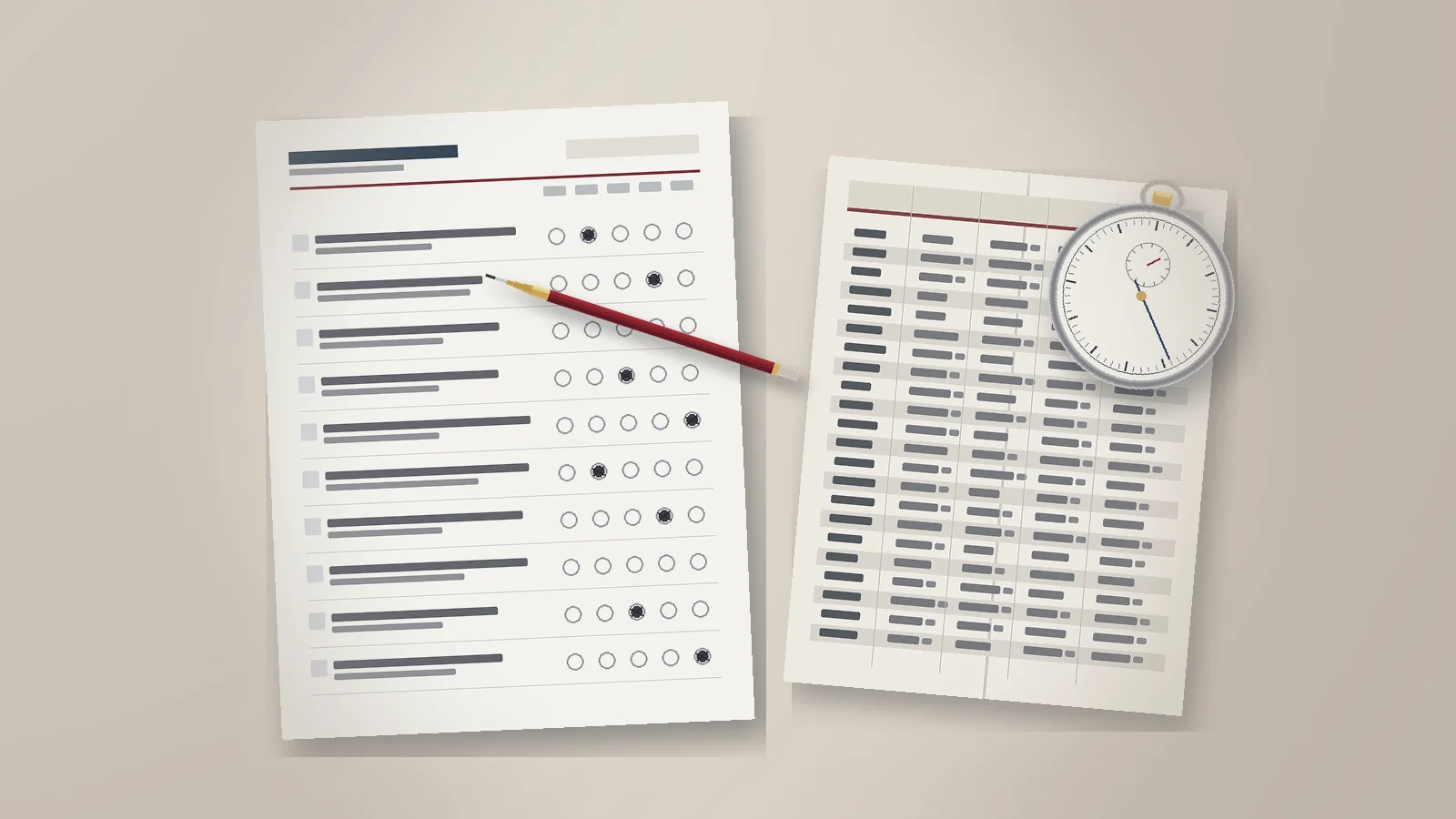
Consider a constructed example. At the week 24 visit of a pivotal trial, the eCOA export shows that a participant answered 8 of the 10 items on the adult PROMIS Short Form v2.0 – Physical Function 10a. Two items are blank, and no reason is recorded. The CRO offers to sum the eight answers and read the nearest row in the manual’s conversion table. A biostatistician asks whether person-mean imputation of the two blanks would be simpler, because it would produce a complete 10-item raw sum. Neither proposal is an official scoring route for this form. Both would put a number in the endpoint dataset that the instrument owner’s scoring instructions do not support.
The short answer: for PROMIS Physical Function short forms, the raw-sum-to-T-score conversion tables in Appendix 1 of the scoring manual apply only when every scored item on that exact form version is answered. The current PROMIS Physical Function User Manual and Scoring Instructions, dated 24 Nov 2025, says so directly:
“All questions must be answered in order to produce a valid score using the scoring tables. If a participant has skipped a question, use the HealthMeasures Scoring Service (…) to generate a final score.”
When an item is skipped, the manual points to response-pattern scoring. That means the free HealthMeasures Scoring Service or an administration platform that calculates scores automatically; the manual gives REDCap auto-score as an example, and HealthMeasures also describes API-powered scoring through the Assessment Center API. Response-pattern scoring uses item-level calibrations and scores exactly the items that were answered. A platform can produce a T-score from a single answered item, but the manual sets a precision floor: a precise score requires at least 4 answered items on forms with 4 or more items, and forms with 1–3 items should be complete. With 8 of 10 items answered, the participant in the example clears that floor, so a response-pattern T-score can be produced, provided the SAP names that route.
Below the floor, the manual says the resulting T-score may not be sufficiently precise and that, depending on how the score will be used, you may discard it or proceed with caution. For a confirmatory endpoint, the defensible choice is usually to prespecify that such a score is treated as missing at that visit. The estimand-aligned missing-data strategy in the statistical analysis plan (SAP) then handles it; the scoring step does not try to repair it.
Two Official Scoring Routes and What Each Assumes
Protocol and data teams should treat these as two different routes. They rest on different completeness assumptions, and the manual says which one applies when items are missing:
Route 1: raw summed-score conversion tables (Appendix 1). Each response option has a printed response score. The scores for all items on the form are summed, and the table for that form and version converts the raw sum to a T-score (mean 50, SD 10) with a standard error (SE). A few PROMIS items have collapsed response categories, where two options share one score, so the manual tells users to take response scores from the respondent-ready measure PDFs rather than assume a fixed 1-to-5 coding.
Route 2: response-pattern (IRT) scoring. The HealthMeasures Scoring Service, the Assessment Center API, and platforms built on it score each response using that item’s own calibration. Two people with the same raw sum but different answer patterns can therefore receive different T-scores. Only answered items contribute to the score.
The tables assume a complete form: each row corresponds to a raw sum that can only be reached when every scored item has a response. In the manual’s worked example for the adult PROMIS Physical Function 4a v2.0 short form, raw scores range from 4 to 16. A raw score of 10 converts to a T-score of 34.4 with an SE of 2.3, giving a 95% confidence interval of 29.9 to 38.9. That is the only published conversion reproduced here. The week 24 example is a constructed illustration, not data from a real trial, and this article reports no study of its own.
HealthMeasures describes response-pattern scoring as more accurate than the summed-score tables and as the preferred method. Because many response patterns produce the same raw sum, table scoring and response-pattern scoring can return slightly different T-scores for the same participant. HealthMeasures notes that this matters more for individual scores and small-group means than for large-group means. For a trial endpoint, it is a reason to fix the route in advance rather than choose it case by case.
How Items Go Missing Before Scoring Starts
Before deciding how to score, operations and data management teams should know where item-level blanks come from. The source determines whether a blank is truly missing, and it determines how often the scoring rule will be triggered.
On paper forms, multiple marks are a documented source. The 24 Nov 2025 manual sets out how multiple responses on a paper form are resolved:
Marks that are not all adjacent: if two or more responses are marked and they are not all next to one another, the item is treated as missing.
Adjacent marks: if two or more marked responses are next to one another, a data entry specialist randomly selects one and writes on the form which answer was selected. For two adjacent marks the manual specifies a coin flip (heads enters the higher number, tails the lower). For three or more, a table of random numbers is used with a statistician’s assistance.
Because this step changes the data that will be scored, the data management plan should say who applies it and where the selection is recorded. In eCOA builds, blanks usually come from the skip behavior the sponsor configures — whether respondents can pass over an item, and whether a soft prompt asks them to confirm a skip — and from interrupted sessions. Document the configured behavior in the eCOA specification, because it determines how often the item-level rule is used. Interrupted or offline sessions can also leave partial records; see our analysis of offline eCOA data capture and audit trails.
One adult form is a special case. The PROMIS Short Form v1.0 – Physical Function Samples with Mobility Aid Users 11a uses screening items, so some items are skipped by design. Its Appendix 1 tables are split by whether the respondent can walk 25 feet (11 items answered) or cannot (8 items answered). Planned skips on that form are not missing data, and the form needs its own row in any worksheet that uses it.
When discrepancies or omissions are found, queries need care. As our guide on endpoint data queries and non-leading respondent communication explains, a query to a site or participant must never suggest a preferred answer or press for a rating just to make an incomplete short form scorable by table.
The Scoring-Route Worksheet: Form, Version, Items Present
To keep site and data teams from improvising, put a form-by-form worksheet in the SAP appendix or data management plan. The table below covers the current adult Physical Function and Upper Extremity short forms listed in the 24 Nov 2025 manual. It uses item counts and item IDs only and reproduces no item text. Retired forms (scored from the manual’s Appendix 2), the v1.0 Physical Function 12a, and the mobility-aid 11a form described above are not listed; check the manual before adding a row for any of them. Upper Extremity and Physical Function T-scores sit on different metrics, and the manual says they cannot be compared. The last column is a recommended SAP choice, not a manual requirement.
| Form and version | Items on form | Items summed for table | Conversion table (Appendix 1) | Response-pattern scoring | Recommended endpoint rule below floor |
|---|---|---|---|---|---|
| PF 4a v2.0 | 4 | All 4 | Only when all 4 are answered | Any skip leaves fewer than 4 answered, so the score is below the floor | Treat as missing |
| PF 6b v2.0 | 6 | All 6 | Only when all 6 are answered | Precise score needs at least 4 answered | Treat as missing |
| PF 8b v2.0 | 8 | All 8 | Only when all 8 are answered | Precise score needs at least 4 answered | Treat as missing |
| PF 8c v2.0 and 8c 7-day | 8 | All 8 | Only when all 8 are answered (one shared table) | Precise score needs at least 4 answered | Treat as missing |
| PF 10a v2.0 | 10 | All 10 | Only when all 10 are answered | Precise score needs at least 4 answered | Treat as missing |
| PF 10b v2.0 | 10 | All 10 | Only when all 10 are answered | Precise score needs at least 4 answered | Treat as missing |
| PF 20a v2.0 | 20 | All 20 | Only when all 20 are answered | Precise score needs at least 4 answered | Treat as missing |
| PF 24a v2.0 (PROMIS HAQ) | 24 | First 21 only | Only when all 21 scored items are answered; Global03, PFScreen, and Global07 are never summed | Precise score needs at least 4 of the 21 scored items | Treat as missing |
| PROMIS+OA-Knee PF 13a v2.0 | 13 | All 13 | Only when all 13 are answered | Precise score needs at least 4 answered | Treat as missing |
| Upper Extremity 7a v2.1 | 7 | All 7 | Only when all 7 are answered | Precise score needs at least 4 answered | Treat as missing |
| PROMISnq PFMS-15a v2.0 | 15 | All 15 | A table exists, but the Appendix 6 supplement adds its own item-level rule | Supplement: mean of available items; assessment missing if 5 or more items are missing (see note) | Follow the supplement after written confirmation |
The flowchart below shows the decision path for an incoming assessment:
flowchart TD
    A["Form exported for scoring"] --> B{"Every scored item answered?"}
    B -- "Yes" --> C["Apply the single route named in the SAP"]
    B -- "No" --> D["Do not use the conversion table, prorate, or impute blanks"]
    D --> E{"Measure has its own item-level rule, such as PFMS-15a?"}
    E -- "Yes" --> F["Apply that rule as confirmed and written in the SAP"]
    E -- "No" --> G{"At least 4 items answered?"}
    G -- "Yes" --> H["Response-pattern scoring: release T-score and SE"]
    G -- "No" --> I["Below the precision floor"]
    I --> J["Record the score as missing at this visit"]
J --> K["Handle with the SAP estimand-aligned missing-data strategy"]Writing the Rule Into the SAP Before Anyone Scores
Choosing a scoring route after database export invites the suspicion that the route was picked for its effect on results. FDA guidance puts instrument-specific missing-item rules in the SAP, where they are fixed before anyone sees the data.
FDA’s final 2009 guidance, Patient-Reported Outcome Measures: Use in Medical Product Development to Support Labeling Claims, has a subsection titled “Missing Items within Domains”:
“At a specific patient visit, a domain measurement may be missing some, but not all, items. One approach to handling this type of missing data is to define rules that specify the number of items that can be missing and still consider the domain as adequately measured. Rules for handling missing data should be specific to each PRO instrument and usually should be determined during the instrument development process. The SAP should specify all rules for handling missing data. For example, the SAP can specify the proportion of items that can be missing before a domain is treated as missing.”
Draft PFDD Guidance 4 (April 2023), Incorporating Clinical Outcome Assessments Into Endpoints for Regulatory Decision-Making, lists among the elements of a COA-based endpoint definition the “rules for handling missing item responses or task results when computing COA scores, along with justification for the rules.” It adds that missing item-level COA data should be handled based on the instrument’s scoring algorithm. Where data are missing for entire domains or measurements, sponsors should propose statistical methods that account for missing data with respect to the estimand, addressed in the SAP. The document is a draft distributed for comment and is not for implementation, and even final FDA guidance contains nonbinding recommendations. Neither document names PROMIS or endorses a particular route. The 4-item floor comes from HealthMeasures, not from FDA.
Building on our analysis of what must be locked in statistical analysis plans for endpoints and our framework for constructing COA endpoints under draft PFDD Guidance 4, the SAP should contain explicit item-level scoring language:
Name one route per form version and the edition it follows: for example, response-pattern scoring through the HealthMeasures Scoring Service or a named API-based platform for every assessment. Alternatively, use Appendix 1 tables for complete forms and response-pattern scoring for incomplete ones, with a justification, since the two routes can give slightly different T-scores for the same responses. Cite the 24 Nov 2025 manual and record the calibration setting used (the Scoring Service instructions say to select the default calibration sample).
Prespecify the floor: for forms with 4 or more items, a score is released for the endpoint only when at least 4 items are answered. For forms with 1–3 items, a score is released only when all items are answered. State any measure-specific rule, such as PFMS-15a, separately.
Define what happens below the floor: the score for that visit is recorded as missing for the endpoint. Data management and programming do not prorate raw sums or impute blank items to reach a table row. If below-floor scores are kept for another purpose, such as descriptive listings, say so and label them.
Align with the estimand: below-floor and uncompleted assessments flow into the prespecified primary and sensitivity analyses (for example, MMRM or multiple imputation). Those analyses must match the ICH E9(R1) estimand and its intercurrent-event strategies, so the scoring step does not quietly become an analysis decision.
When the Score Should Stay Missing
A platform being able to output a number does not make that number fit for an endpoint.
HealthMeasures states that a single item alone produces a T-score with “significantly more error” and advises administering at least 4 items when a precise score is needed. For scores below the floor, the manual says the T-score “may not be sufficiently precise” and that, depending on use, teams may discard it or proceed with caution. Releasing such scores into a confirmatory endpoint adds measurement error the analysis was not designed to absorb, and it makes the precision of each released score depend on how many items each participant happened to skip.
Teams used to classical scoring often propose the “Half Rule” instead: score the form if more than half the items are answered, usually by averaging them. A 2026 simulation study in the Journal of Patient-Reported Outcomes, informed by a review of 87 PRO instruments, describes the Half Rule as widely used in PROM user manuals. It notes that PROMs scored by summing all items typically treat the score as missing if any item is missing, while mean-scored PROMs commonly require more than 50% of items answered.
When an assessment falls below the floor, the defensible action is to let the score stay missing. As our article on missing data versus intercurrent events under ICH E9(R1) explains, missing assessments are handled by the prespecified estimand-aligned primary analysis and its sensitivity analyses, not by improvising at the scoring step.
Releasing and Recording the Route
Putting the scoring route into practice requires coordinated work across data management, statistical programming, and trial master file (TMF) filing:
Fix one route across the trial: because summed-score tables and response-pattern scoring treat responses differently, do not switch methods between sites, visits, or interim and final analyses. A single response-pattern scoring engine keeps every released score on the same footing.
Run the Scoring Service with its built-in checks: the service is free and web-based, with no software installation or licensing required. Download the input template and add all respondents’ item responses for one measure (multiple time points are allowed), saved as a .csv file. HealthMeasures says the upload contains only assessment numbers, item IDs, raw response scores, and a participant code of your choosing. If the SAP applies the floor, remove respondents with fewer than 4 answered items before upload, as the service instructions direct. Results arrive by email with several attachments, including a T-score file. Then review the log file to confirm every expected item was used, which catches item-ID errors.
Pin the edition: archive the dated 24 Nov 2025 PDF, the SAP rule, and the scoring input, output, and log files in the TMF. HealthMeasures lists current editions on its PROMIS Scoring Manuals page, which was last updated October 8, 2026, when checked for this article. Manual files and links change over time, so re-check the edition at each SAP amendment and before database lock.
Keep validation and licensing with the sponsor: HealthMeasures’ pages describe the service’s scoring method but do not address sponsor computerized-system validation or 21 CFR Part 11 responsibilities. Those remain sponsor obligations whether scoring runs through the service, an eCOA vendor’s integrated scoring, or the sponsor’s own validated programs. The manual also sets out when programming PROMIS measures into a digital platform needs HealthMeasures approval. See our guides to COA licensing before an eCOA build and to COA measurement properties and the evidence a trial still needs.
A prespecified route, an explicit floor, a below-floor rule, and archived scoring records let a reviewer reproduce every released score. They make the scoring step defensible; they do not by themselves establish that the endpoint is acceptable to a regulator, which depends on the wider COA evidence package.